

As much as I hate my current doomscrolling era where I keep consuming a lot of political debates on Youtube, I am glad that I pickup some gems along the way. These are as rare as needles in a haystack, but I consider that I do possess the ability to identify and pick those needles.
Serendipity through Yogendra Yadav
Yogendra Yadav is famously known to have predicted the 2024 election results even though he has miserably failed to do any decent psephological work in the last few years. I consider it as a luck. He got kicked out of AAP and later became a side kick of Rahul Gandhi. But he seems to enjoy protests and interviews on news media.
On the topic of SIR (special intensive revision), Yadav tried to formulate a broader theory about how the current BJP works. He proposes a theory rooted in Indian or Hindu philosophy which talks about Deśa (देश - Place/Space), Kāla (काल - Time/Circumstance), and Pātra (पात्र - Person/Recipient).

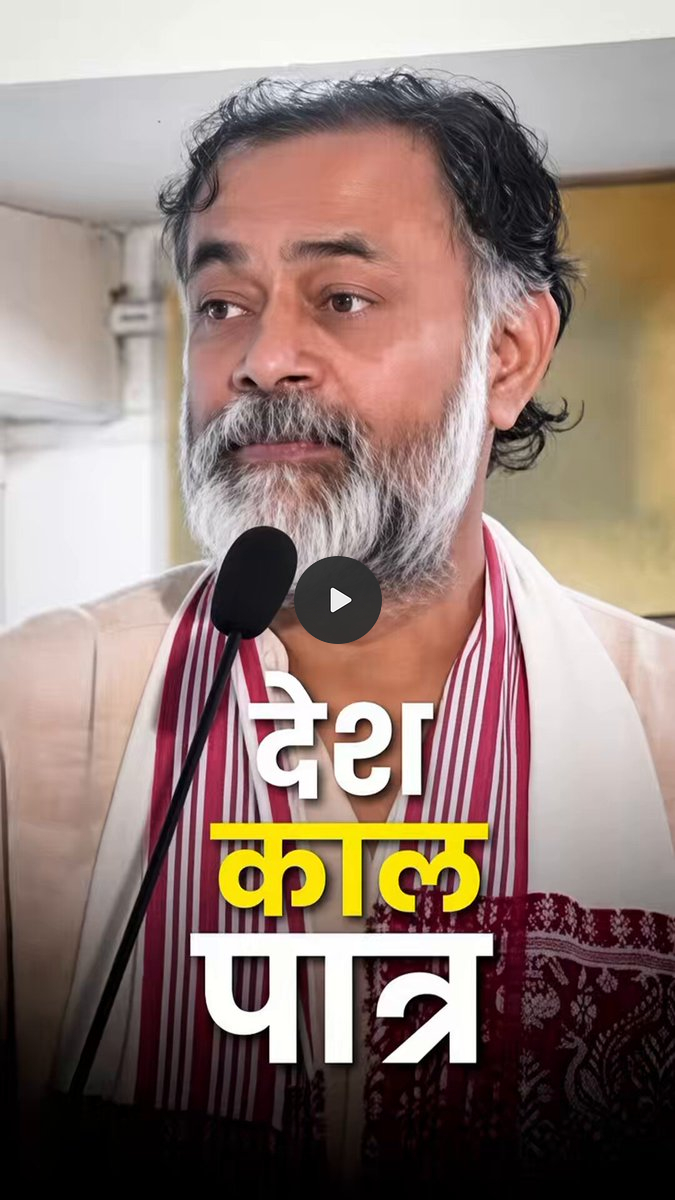
According to him the current BJP is trying to fix the geography through delimitation, electorate through SIR, time through one nation one poll to ensure that it keeps on winning forever. I don’t buy into this theory, or maybe it’s true to some extent. But the framework seems compelling.
The Philosophical Roots
Thanks to the hyped technology of AI, I went down the rabbit hole to find the roots of these terms in our literature and found three good verses which correctly explains the meaning of Desha, Kaala, Patra.
देशं कालम् च पात्रं च ज्ञात्वा कर्म समाचरेत्।
अनभिश्रो च मूढो वा कर्मणा न विधीयते॥
Transliteration:
deśaṁ kālam ca pātraṁ ca jñātvā karma samācaret |
anabhijño ca mūḍho vā karmaṇā na vidhīyate ||
Translation:
“Having understood the place, the time, and the recipient/capacity, one should execute an action. One who acts without assessing these three is ignorant and foolish, and their work yields no result.”
देशानुकूलं कालोचितं पात्रयोग्यं वचः स्मृतम्।
अन्यथा चोक्तमप्येतद् व्यर्थं भवति भाषितम्॥
Transliteration:
deśānukūlaṁ kālocitaṁ pātrayogyaṁ vacaḥ smṛtam |
anyathā coktam apyetad vyarthaṁ bhavati bhāṣitam ||
Translation:
“Speech should be harmonious with the place, suitable to the time, and appropriate for the listener (recipient).Otherwise, even well-intentioned words become entirely futile.”
दातव्यमिति यद्दानं दीयतेऽनुपकारिणे।
देशे काले च पात्रे च तद्दानं सात्त्विकं स्मृतम्॥
Transliteration:
dātavyam iti yad dānaṁ dīyate ’nupakāriṇe |
deśe kāle ca pātre ca tad dānaṁ sāttvikaṁ smṛtam ||
Translation:
“That gift which is given out of a sense of duty, without expectation of return, at the proper place (deśe), at the appropriate time (kāle), and to a worthy person (pātre), is held to be in the mode of goodness (sāttvika).”
Source: Google Gemini
The three verses, though chosen via probabilistic computation, make perfect sense and can guide an individual regarding how one should behave and what should be spoken in a given scenario. The last one is probably an addendum regarding duties. Put together, these three principles are more expansive than any philosophical or moral doctrine out there.
Personal Implications
So what?
So what if I know this concept? It might be an answer to the continuous complexity and abstraction that I am being forced to deal with. And I wouldn’t be surprised that every individual out there is trying to handle randomness and complexity in their own context.
These three verses will help us navigate the complexity in our own way. As per Desha, Kaala and Patra.