

Note: As I have never been a user of Ola or other ride hailing apps, I will not be comparing Bharat Taxi to other services. Most of my comparisons will be to Uber.
The State of Affairs
Not much is happening in the Indian tech and startup ecosystem these days when compared to the boom between 2020-2022. But recently, something in the news cycle caught my attention. The central government launched an app called “Bharat Taxi”.
Uber and Ola are classic marketplace platforms which absorbed massive losses for almost a decade before they could create a system good enough to inspire a debate on economics of buying a car vs depending on autos, taxis and bikes.
Rapido entered the market and destroyed the duopoly by introducing the “bike taxi”. Subscription driven SaaS play by Rapido and Namma Yatri further killed 30% cuts from the Uber-Ola duopoly.
Platforms like InDrive introduced the negotiation and price discovery model. It’s more of a drag in my opinion, given the lack of “revolution” that was expected to bring about.
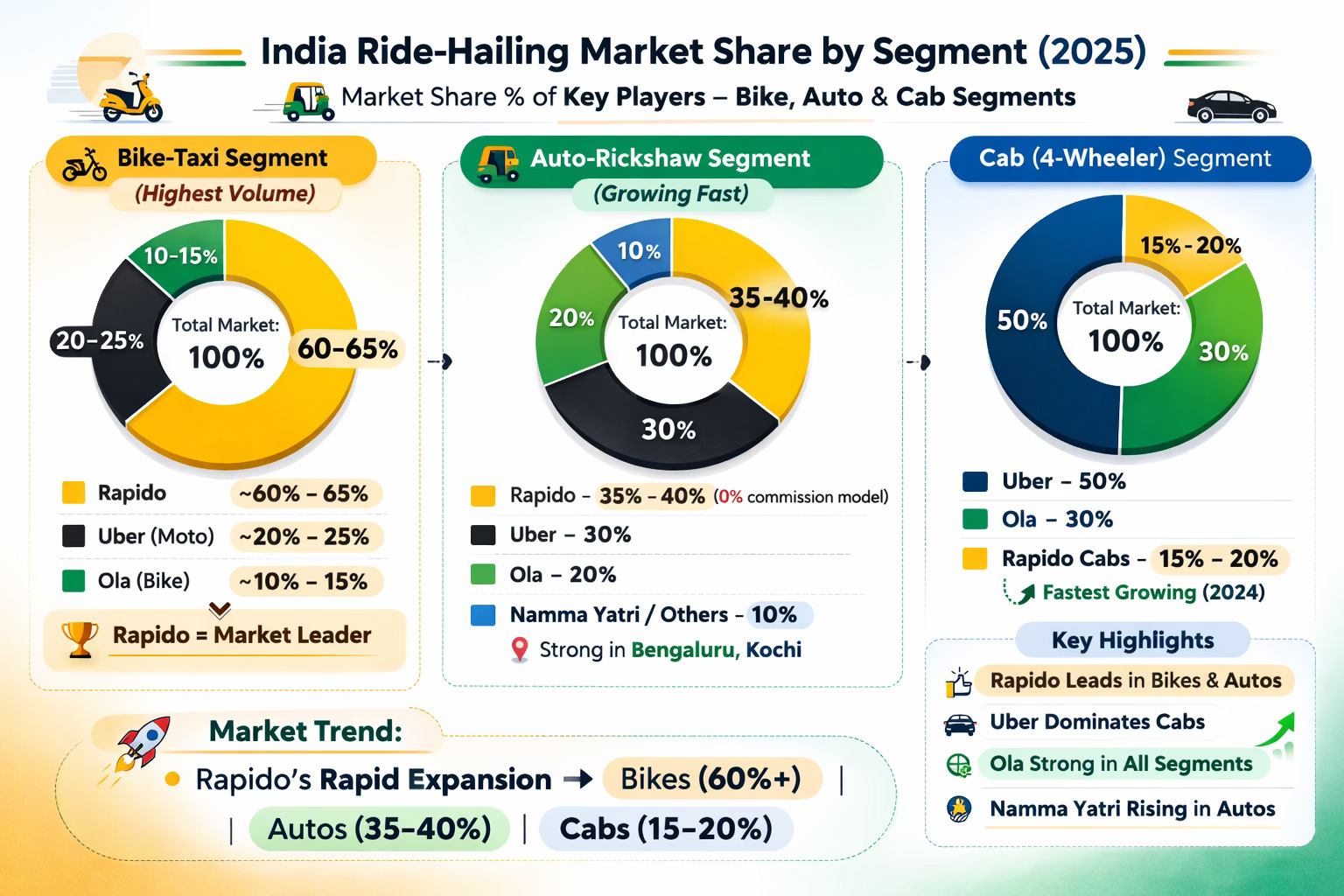
The landscape of ride hailing platforms before entry of Bharat Taxi looked like this (based on data between 2023 and 2025).
Us vs Them
But the platforms have optimised for users rather than drivers, and later further moved in the direction of optimising for profits over both riders and drivers.
What they didn’t see coming was an alternative model i.e. a cooperative platform taking on their VC pipe dreams on monopoly/duopoly destroying their entire thesis.
The need for change has always been there. During every bike ride, I have heard drivers complaining about delayed payouts.
“Companies are running taxis for their own benefit, whereas Bharat Taxi is for the benefit of Sarathis (drivers),” Shah said.
It’s important to note that Uber, Rapido and Ola succeeded because they were able to advocate for better user experience, reliability and price discovery for the passenger.
This might slightly titillate the hopes of many well-meaning users and citizens who are concerned about income inequality and anti-labour behaviour of big tech platforms.
The co-ownership model is not fiction but a reality embedded in the structure of Bharat Taxi.
Shah said that under the cooperative structure, if Bharat Taxi earns Rs 25 crore after three years, 20% of the amount would be retained as cooperative capital while 80% would be distributed among drivers based on the number of kilometres driven.
Source : ET
This is definitely an enticing deal for the driver community.
Competing Against Incumbents
But one must note that Uber, Rapido and Ola are mature platforms that have established user trust, learnt from data and built systems to address many problems linked to mobility space.
For Bharat Taxi to succeed it needs to perform as good as its competitors on passenger satisfaction while simultaneously improving driver incomes and experience.
One needs to benchmark or evaluate Bharat Taxi experience for users on two important axes to make any reasonable guesses about its potential for success.
Price
Safety
Price
On the price front, Bharat Taxi seemed to be more expensive than Uber-like alternatives. But we are not sure how the overall spend of a consumer would look like. Incumbents are notoriously good at offering a cheaper first ride and then charging more for the return ride.
The price models that Uber has built with almost a decade of consumer data would be miles ahead of Bharat Taxi. In addition subscription products like Uber One and better brand recall for older apps could trump Bharat Taxi.
The “no surge” promise on part of Bharat Taxi could prove to be useful. Generally a user would have multiple apps on their phone. I have seen a friend comparing prices on InDrive, Uber, Ola and Rapido before making a choice. We have enough time to research which service would cost the least and pick exactly that.
If capital were to be a deciding factor in the fight for market share, incumbents would have deep pockets and the Bharat Taxi would have to rely on the “ownership” promise to clog the supply side in this fight.
But cost for passengers, I feel is the “driving” factor in adoption and sustenance of an urban transport marketplace. The volume of bike rides in comparison to auto and cabs is a definite indicator of price sensitivity of the Indian consumer.
Earnings and ownership dreams of drivers would be punched down by the passenger preferences and ride volumes on Bharat Taxi in comparison to other established platforms.
When I took a short ride on Bharat Taxi last week, I asked the bike driver if he got enough rides on the app. He mentioned that it was kinda low given that it’s new player in the market.
Safety
Will the “owner” mentality of the driving community have any downside on the safety aspect? Hopefully not.
Current players have had to bear the brunt of multiple instances of negative media due to safety concerns. But the brand itself has not taken a devastating hit on this front.
Services like Uber, Ola and Rapido have almost become an essential commodity for many urban commuters. The negative perception on the safety front often tilts towards the drivers and not inadequate systems built by the ride hailing platform.
The same scenario applies to Bharat Taxi as well. But consumer trust is likely to fall only if the user feels that the new option is far worse than incumbents on the safety front.
One must note that Bharat Taxi has more or less the same safety features as current players on its app. I am sure they would have studied the product and executed something similar.
The limiting factor in passenger safety is not really the app or its features but the driver’s themselves.
Predictions
I am not a qualified industry expert. But from a user’s perspective I don’t see any significant differentiating factor between Bharat Taxi and other players.
Also, my predictions are based on the assumption that Bharat Taxi or unions don’t stop or discourage drivers from multiple platforms in future.
Bharat Taxi has space to manoeuvre if it can drastically shake up the supply side for its competitors, i.e. driver and vehicle availability. If it does so by seeking more money from passengers, it is bound to fail.
Given the delicate balance required for growth, I don’t see Bharat Taxi capturing more than 10-20% in the near term (say 2-3 years). The promise of equity and profit share is a long term game which majority of drivers may not be ready to play.
The drivers, especially bike taxi drivers would be happier if they get more rides. The platform doesn’t matter much for them as long as they are able to earn decent money.