

ಮುತ್ತಿನಂಥ ಮಾತೊಂದು ಗೊತ್ತೇನಮ್ಮ, ನಿನಗೆ ಗೊತ್ತೇನಮ್ಮ
ನಾವು ಕಾಲಕ್ಕೆ ತಕ್ಕಂತೆ ನಡೆಯಬೇಕು, ಎಂದೂ ತಾಳಕ್ಕೆ ತಕ್ಕಂತೆ ಕುಣಿಯಬೇಕು.
Muttinantha maatondu gottenamma, ninage gottenamma
Naavu kaalakke takkante nadeyabeku, Endu taalakke takkante kuniyabeku.
Do you know a pearl-like word of wisdom?
We must walk according to the times, and dance to the rhythm of life.
~ Kannada Song from the Movie Bahadur Gandu (1976)
The weather in Delhi was pleasant this morning. I managed to wake up early and take a bath. I mention the bath because doing something so basic has been difficult lately. Fret not, I still shower after my evening fitness sessions.
As per my much-ignored plan, I had five eggs and some sprouts. Yes, I need to load up on protein to aid my weight loss. While driving from home to the office, I decided to play some chill Kannada oldies as opposed to confrontational songs from Dhurandhar, or something along those lines.
I stumbled upon a funny yet insightful song that makes perfect sense in my current context. By the way, don’t be misled by the song’s cover art. It is a fun, teasing song that manages to carry meaningful lyrics. It’s exactly the kind of teasing my mind needs right now.
I had finally put myself in a good mood where I recalled that I had still not written a review of a great book I had read last month.
The Core Idea
The decisions we make in our lives—in business, saving and spending, health and lifestyle choices, raising our children, and relationships—easily fit von Neumann’s definition of “real games.” They involve uncertainty, risk, and occasional deception, prominent elements in poker. Trouble follows when we treat life decisions as if they were chess decisions.
Annie Duke, Thinking in Bets
The quote above seems so obvious, but I had been so blind to this worldview. Just because I try to work on the basis of logic and fairness, it doesn’t mean that the world is operating with the same framework.
Annie Duke’s core idea is that life is not like chess, where moves are predictable and victory can be sealed with logic. She argues that life is more like poker where luck matters. Quality of decisions may not always reflect quality of outcomes.
Of course, none of us are too naive to think everything works on logic. But we don’t acknowledge the role of luck and the correlation between quality of decisions and quality of outcomes.
From time to time we do mention luck, but that happens when we don’t get what we want. In addition we don’t attribute bad outcomes to luck and may do the mistake of attributing it to a well-thought decision. Annie Duke calls out this mistake.
She tries to explore when to attribute a bad outcome to luck and when to fix the decision process. In addition the author explores how to avoid bad decision making processes and mitigate the fundamental risks associated with real games.
I don’t want to get into the loop of writing a summary of the book. A very good summary of it is already available online.
I shall list out some key takeaways in the book apart from couple of points I’ve already mentioned above.
Useful Resets
Thinking about the past decisions and regretting choices made has no value. The author explains this with the examples of branches of a tree (a section that I would want to revisit).
Every decision commits you to some course of action that, by definition, eliminates acting on other alternatives. Not placing a bet on something is, itself, a bet.
~ Derek Siver’s summary of the book
I have tried to actively stop myself from believing everything and ask questions most of the time. But not as much as I would want to. This makes me think about all existing beliefs and how I can revisit them and rewrite them wherever appropriate
This is how you *think* you form beliefs:
(1) You hear something.
(2) You think about it and vet it, determining whether it is true or false.
(3) Only after that, you form your belief.
It turns out, though, that you *actually* form abstract beliefs this way:
(1) You hear something
(2) You believe it to be true
(3) Only sometimes, later, if you have the time or the inclination, you think about it and vet it, determining whether it is, in fact, true or false.~Derek Siver’s summary of the book
Of course we know that the future can’t be predicted. But if we can sit down and imagine possible futures based on data of the past, we can use our free will to make choices that can lead to a better future. Again this is not a Eureka moment. But the fact that don’t practice it often is what should worry us. This diagram from the book is definitely worth remembering.
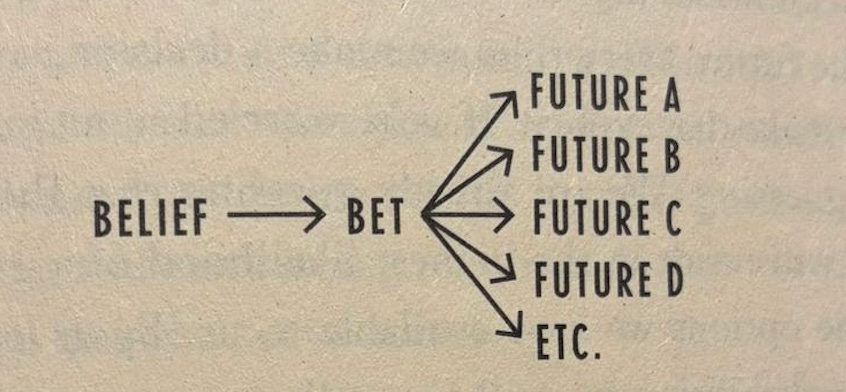
One can make many more notes from the book. But these are the most important and useful ideas as far as I am concerned. But I would highly encourage you to read the book. It is well written and it’s not preachy like a self help book.